Saturday, 19 October 2019

CERVICAL SPONDYLOSIS AND ITS MANAGEMENT BY AYURVEDA

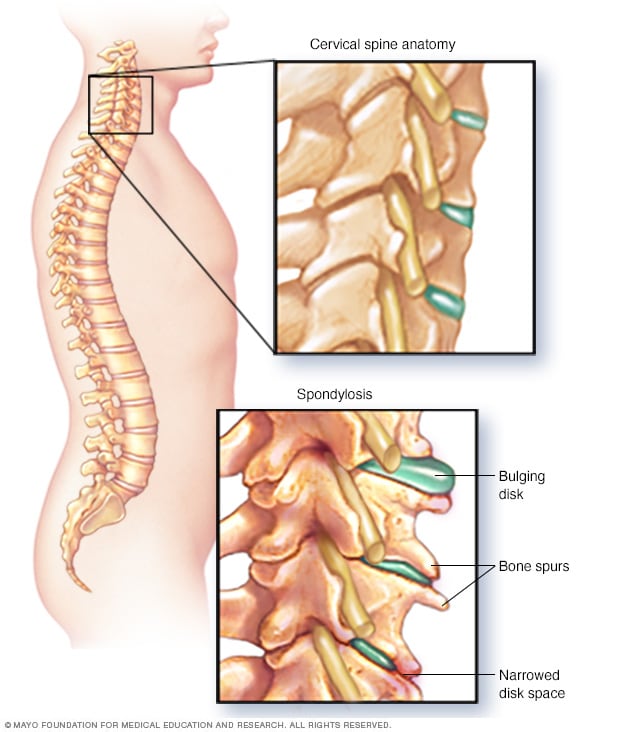
Cervical spondylosis is a general term for age-related wear and tear affecting the spinal disks in your neck. As the disks dehydrate and shrink, signs of osteoarthritis develop, including bony projections along the edges of bones (bone spurs).
Cervical spondylosis is very common and worsens with age. More than 85 percent of people older than age 60 are affected by cervical spondylosis.
Most people experience no symptoms from these problems. When symptoms do occur, nonsurgical treatments often are effective.

Symptoms

For most people, cervical spondylosis causes no symptoms. When symptoms do occur, they typically include pain and stiffness in the neck.
Sometimes, cervical spondylosis results in a narrowing of the space needed by the spinal cord and the nerve roots that pass through the spine to the rest of your body. If the spinal cord or nerve roots become pinched, you might experience:
  • Tingling, numbness and weakness in your arms, hands, legs or feet
  • Lack of coordination and difficulty walking
  • Loss of bladder or bowel control

Causes

As you age, the bones and cartilage that make up your backbone and neck gradually develop wear and tear. These changes can include:
  • Dehydrated disks. Disks act like cushions between the vertebrae of your spine. By the age of 40, most people's spinal disks begin drying out and shrinking, which allows more bone-on-bone contact between the vertebrae.
  • Herniated disks. Age also affects the exterior of your spinal disks. Cracks often appear, leading to bulging (herniated) disks — which sometimes can press on the spinal cord and nerve roots.
  • Bone spurs. Disk degeneration often results in the spine producing extra amounts of bone in a misguided effort to strengthen the spine. These bone spurs can sometimes pinch the spinal cord and nerve roots.
  • Stiff ligaments. Ligaments are cords of tissue that connect bone to bone. Spinal ligaments can stiffen with age, making your neck less flexible.

Risk factors

Risk factors for cervical spondylosis include:
  • Age. Cervical spondylosis is a normal part of aging.
  • Occupation. Jobs that involve repetitive neck motions, awkward positioning or a lot of overhead work put extra stress on your neck.
  • Neck injuries. Previous neck injuries appear to increase the risk of cervical spondylosis.
  • Genetic factors. Some individuals in certain families will experience more of these changes over time, while others will not.
  • Smoking. Smoking has been linked to increased neck pain.

Complications

If your spinal cord or nerve roots become severely compressed as a result of cervical spondylosis, the damage can be permanent.
Ayurveda Management
According to Ayurveda the Vata, the principle of movement is the predominant function with the skeleto-muscular system and the nervous system. Problems relating to these systems are predominantly caused by vitiated Vata.
Vatavyadhis comes under a group of diseases which manifest by dhatu kshaya or margavarana and those are classified according to hetu, sthana and lakshana. In the classification of dhatukshayajanya vatavyadhis, many degenerative conditions are considered. Cervical spondylosis can be considered one among them and can be compared with ‘Vishwachi’.
Treatment in Ayurveda is aimed at restoring the equilibrium through correction of the underlying functional in-equilibrium.
 The treatment for Cervical Spondylosis is comprehensive and may include Ayurveda internal medicines & external applications for mild cases and along with these, Ayuveda Panchakarma therapies in severe cases. Diet and lifestyle modifications are applied in both the scenarios.
Panchakarma therapies like Abhyanga swedam, Elakizhi, Nasyam, Shirovasti or shirodhara, Sarvangadhara, Greeva basti, Navara or mamsa kizhi, Vasti are usually done based on the persons presentation and severity of the disease. Average duration of therapy may range between 4 – 6 weeks and most of the cases experience high recovery.

Dr Aravind
Head of the Clinical Services
Punarnava Ayurveda Hospital, Himachal Pradesh
India
9008115952
vdaravind@gmail.com
dr.aravind@punarnava.org

Saturday, 5 October 2019

QUALITIES OF GOOD AYURVEDA PHYSICIAN

In Ayurveda , Acharya has mentioned about qualities and duties of vaidya (physician) regarding treatment of patient. Astanga sangrahakar has given four qualities of physician while delivering medical care. Those are ;
1) Daksha - alertness,
2) Tirthattshatrath - Physician must have knowledge obtain from guru(teacher)
3) Drushtkarma - must have experience of treating patient.
4) Shuchi - should maintain hygiene externally and internally as well.

Acharya Charaka has mentioned fourfold attitude of physician , those are;

1) Maitri - Friendly relation with the patient,
2) A good and kind behavior towards patient or ill people,
3) A good nursing care should be there while treating patient,
4) Good counseling to the patient or relative, when patient is in untreatable condition.

Dr Aravind
Head of the Clinical Services
Punarnava Ayurveda Hospital, Himachal Pradesh
India
9008115952
vdaravind@gmail.com
dr.aravind@punarnava.org


Tuesday, 1 October 2019

MODE OF ACTION OF AGNIKARMA IN CHIKITSA OF GRUDHRASI (SCIATICA)

 Ayurveda mainly concentrate on bringing back the vitiated vata dosha in the state of equilibrium. 

Agnikarma with lohashalaka 2 sittings in 8 days

Agnikarma: 

Agnikarma Sthan: “Antarakandaragulpha” 

Upkarana:Lohashalaka


During Main Procedure (Pradhana Karma): 


Examine the patient carefully and mark the maximum tender points on and around L4 –L5 vertebral bodies and Sciatic notch. Paint the portion by Aseptic solutions like Triphala Kwath, Panchvalkal Kwath or Betadin liquid and drap. With the use of Red hot Agnikarma probe and skilled hands, give 4-6 therapeutic burn marks with a distance of an inch up to skin level on spinous process and transverse process of L4 and L5 body. Also give 2-3 therapeutic burn marks at the level of sciatic notch when Cross SLR test become positive. Give 2-3 therapeutic burn marks longitudinally on 
tendo Achilles ligament (Antra kandara gulf Madhya as per Ayurveda)

on affected limb when popliteal compression test get positive. Instantly apply the pulp of Kumari (Aloe vera) leaf hold with swab holding forceps in small piece on the burn marks, as Kumari (Aloe vera) is working as instant cooling agent

PROCEDURE DONE WEEKLY i.e. two times

Since the therapy for Grudhrasi has limitation in other pathies, the unique combination of Ayurvedic herbs kwatha and Agnikarma can be effective therapy in Grudhrasi.

Dr Aravind
Head of the Clinical Services
Punarnava Ayurveda Hospital, Himachal Pradesh
India
9008115952
vdaravind@gmail.com
dr.aravind@punarnava.org


Tuesday, 24 September 2019


PUNARNAVA AYURVEDA HOSPITAL 
THE HIMALAYAS ARE YOUR
NEW HEALING DESTINATION


Today Ayurveda is popular  the world over. However, often its principles, concepts and values are not adhered to in its actual application leading to a reduction in its beneficial effect. It is the objective of Punarnava to create and maintain precious and yet cost-effective well-being for the global community in the context of current health challenges using Ayurveda and other traditional knowledge systems. Punarnava's  endeavour  is to see how authentic Ayurveda can be made contemporary without  tampering with its core values.
Punarnava Ayurveda was established with the Vision of “Authentic Ayurveda for Universal Well-being".
This organisation is the outcome of the knowledge and the experience of 5 individuals who share a common objective of the creation and sustenance of global wellness through Ayurveda and other traditional medical knowledge systems. Four Ayurveda physicians with a combined experience of more than 100 years and 200,000 patients of varied disorders bring to Punarnava the wealth of their knowledge and experience.

We are a growing family and today there are more than 70 people who support this journey; and more than 150 people who are part of this journey on a day to day basis.
Punarnava Ayurveda was established in 2004. In 2009, we established Vaidyagrama  Ayurveda healing village outside Coimbatore in South India. Today this village has 36 patient units and treats patients from all over the world for conditions ranging from neuro-musculo-skeletal disorder, respiratory and cardiac disorders, reproductive health disorders, skin disorders, gastro-intestinal disorders etc. Punarnava Ayurveda hospital started functioning from August 06 2019 in Baddi, Himachal Pradesh in North India.
At PUNARNAVA, patients with many different conditions arrive for treatment. We do work with all these different conditions including patients with different types of cancer, and patients have achieved different levels of benefit depending on various factors including age, chronicity of the problem, diet and lifestyle etc. We primarily work with –
1.     Neuro musculo skeletal disorders
2.     Skin disorders
3.     Gastro intestinal disorders
4.     Respiratory system disorders
5.     Chronic cardiac disorders
6.     Chronic hormonal disorders
7.     Reproductive disorder
Also treatment programs for general health maintenance and rejuvenation are given.
You are most welcome to visit our website https://avspunarnavaayurveda.com/ 
With warm wishes,

Dr Aravind
Head of the clinical services
Punarnava Ayurveda Hospital, Baddi,
9008115952
dr.aravind@punarnava .org